Hear the 1912 election in the candidates' own voices, restored
Theodore Roosevelt, Woodrow Wilson and William Howard Taft recorded their 1912 campaign speeches for Victor. Hear the Library of Congress discs before and after restoration with Diffio AI.
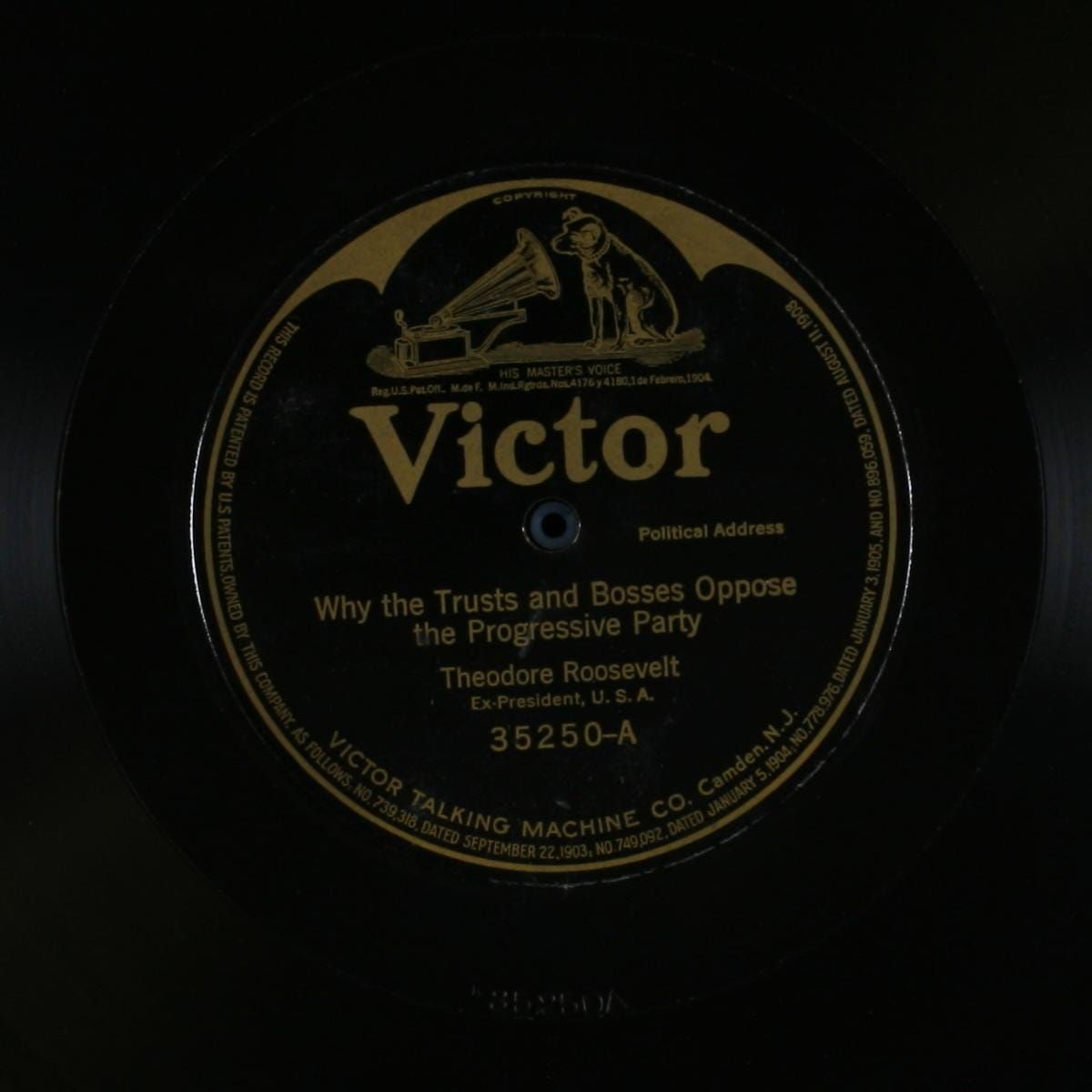
In the fall of 1912 three men who had been or would become president recorded their campaign arguments for the Victor Talking Machine Company. Theodore Roosevelt, running as a Progressive, recorded on September 22. Woodrow Wilson, the Democrat, recorded on September 24. William Howard Taft, the sitting Republican president, recorded on October 1. Victor issued the speeches on disc, so voters could play the candidates' own voices on a phonograph at home.
The discs survive, digitized by the Library of Congress for its National Jukebox. They are acoustic recordings, made without a microphone, and the voices sit under a century of hiss and crackle. For Election Day we ran three of them through Diffio AI, our speech restoration tool. This page puts each original next to its restoration so anyone can hear both. Each pair is the same passage, matched for loudness, so what changes is the noise and the voice, not the volume.
Watch: Roosevelt, before and after
Theodore Roosevelt: "They dread you, the people"
From "Why the Trusts and Bosses Oppose the Progressive Party" (Victor 35250-A). Roosevelt is answering Standard Oil's John D. Archbold and Senator Boies Penrose, who had testified against him that year, and turns their attacks into his case for the Progressive platform:
"The fundamental motive that induces them to act as they have acted in this manner is not merely that they dislike me, but far more because they dread you. They dread you, the people, you and those like you who make up the people of the United States. They know that their time has come if once the people obtain real power. We stand for the rights of the people. We stand for the rights of the wage worker. We stand for his right to a living wage."
Original (Victor 35250-A, recorded September 22, 1912)
Restored with Diffio
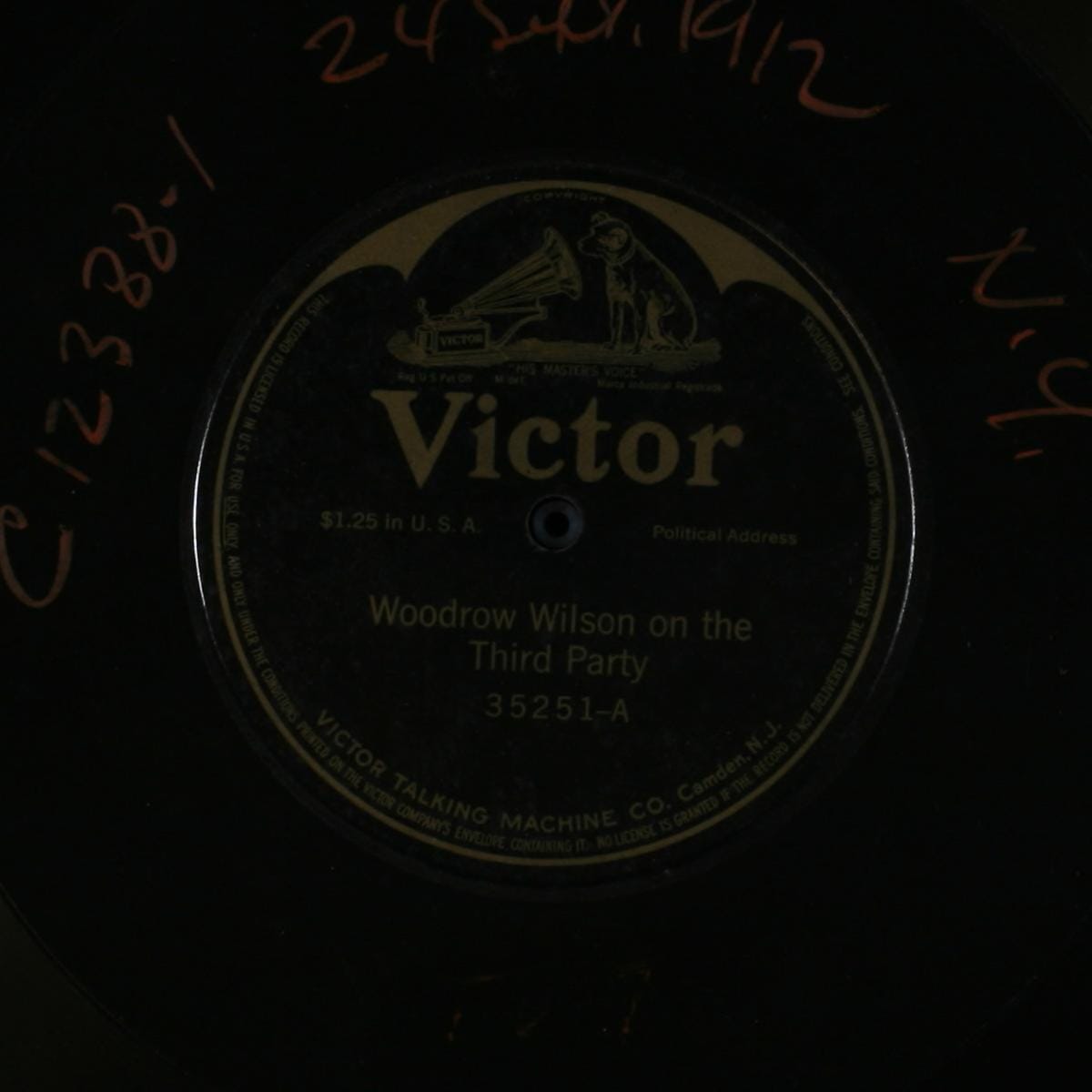
Woodrow Wilson on the third party
From "Woodrow Wilson on the Third Party" (Victor 35251-A). Wilson argues that Roosevelt's plan to regulate the trusts would make partners of the men it meant to control:
"Mr. Roosevelt puts forth an admirable platform of what he would like to do for the people. But how is he going to do it? He proposes in his platform not to abolish monopoly but to take it under the legal protection of the government and to regulate it. In other words, to take the very men into partnership who have been making it impossible to carry out these great programs by which all of us wish to help the people."
Original (Victor 35251-A, recorded September 24, 1912)
Restored with Diffio
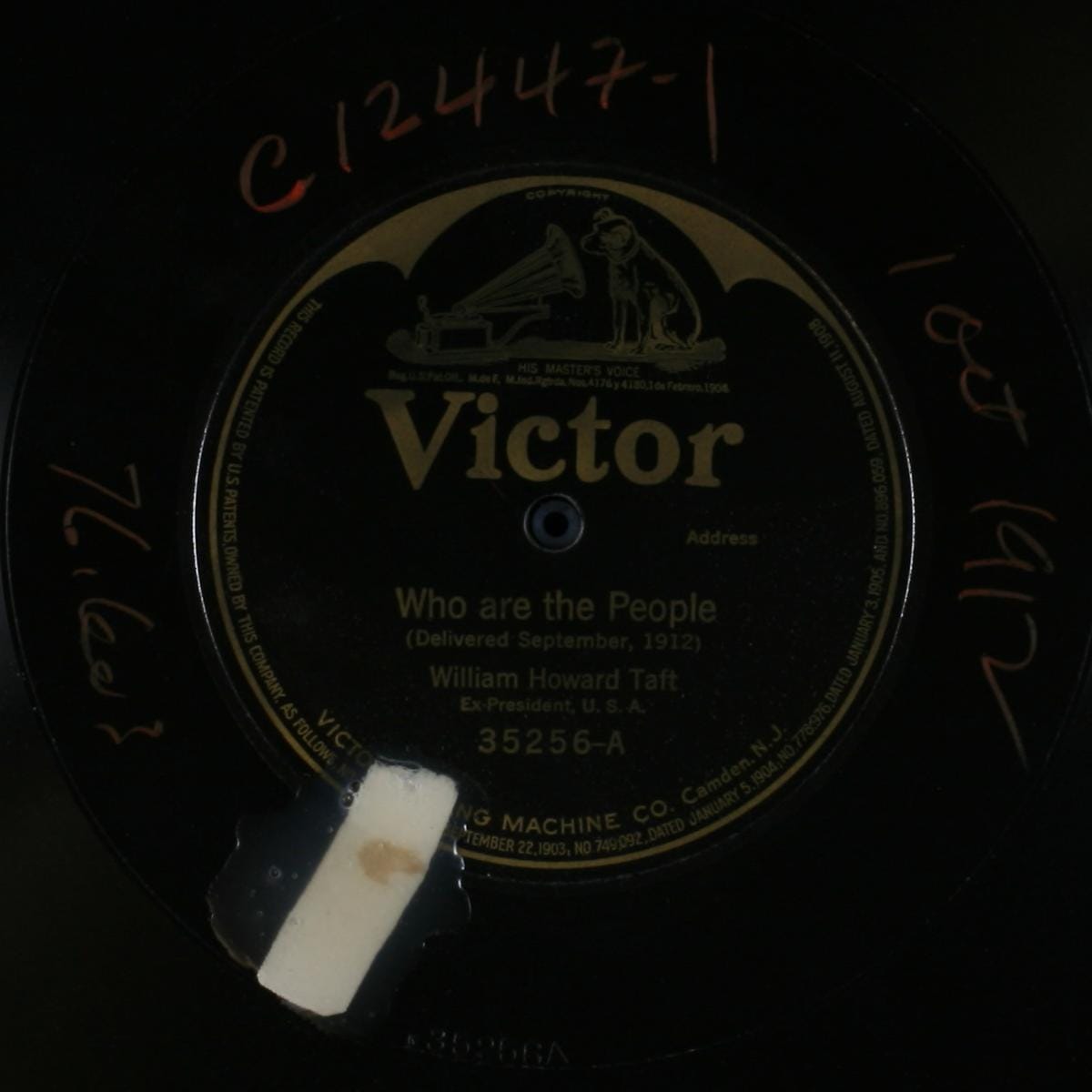
William Howard Taft: "Who are the people?"
From "Who Are the People" (Victor 35256-A). Taft, the incumbent, answers both challengers' claim to speak for the people:
"Who are the people? They are not alone the unfortunate and the weak. They are the weak and the strong, the poor and the rich, and the many who are neither. The wage earner and the capitalist, the farmer and the professional man, the merchant and the manufacturer, the storekeeper and the clerk, the railroad manager and the employee. They all make up the people."
Original (Victor 35256-A, recorded October 1, 1912)
Restored with Diffio
Wilson won the election on November 5, 1912. Roosevelt came second, the only third-party candidate ever to do so, and Taft third. More than a century later, their argument about who speaks for "the people" still sounds familiar.
What changed
Diffio restores recorded speech. It separates the voice from everything else in the recording and rebuilds it so it sounds closer to a clean microphone. On these discs the surface noise drops away and the voices come forward.
The models are generative, which is why the result can be so much clearer than a noise filter manages on audio this old. It is also why we publish each original next to its restoration. We treat the restored files as listening copies: the originals stay exactly as the Library of Congress digitized them, and anyone quoting these speeches should check the words against the originals. The quotations on this page are from our own transcription; the full discs are in the National Jukebox.
The same kind of restoration works on recordings much closer to home: a family cassette, an interview recorded on a phone, a radio program saved on reel-to-reel. If you have one, you can try Diffio on three uploads without a card.
For journalists, educators and museums
The original recordings are in the public domain: they were first published in 1912, and U.S. sound recordings published before 1923 entered the public domain in 2022. The restored audio and the video on this page are free to use for press, classroom and museum work. Write to me at nathan.harmon@trydiffio.com if you'd like WAV files or the full restored discs. Please credit "Audio: Victor Talking Machine Co. (1912), Library of Congress National Jukebox; restored with Diffio AI (diffio.ai)".
Nathan Harmon is the founder of Diffio AI, based in Colorado Springs.